Suvat Equations: Complete Guide with Formula Sheet, Examples & Calculator
Introduction
Suvat equations are among the most important formulas in physics, helping students solve problems involving motion with constant acceleration. Whether you are preparing for GCSE Physics, A-Level exams, or simply improving your understanding of mechanics, learning these equations can make solving kinematics questions much easier.
This complete guide explains everything you need to know about suvat equations, including the meaning of each variable, the complete formula sheet, practical examples, and how to choose the correct equation. By the end of this article, you will have a strong understanding of the topic and be ready to solve motion problems with confidence.
What Are Suvat Equations?
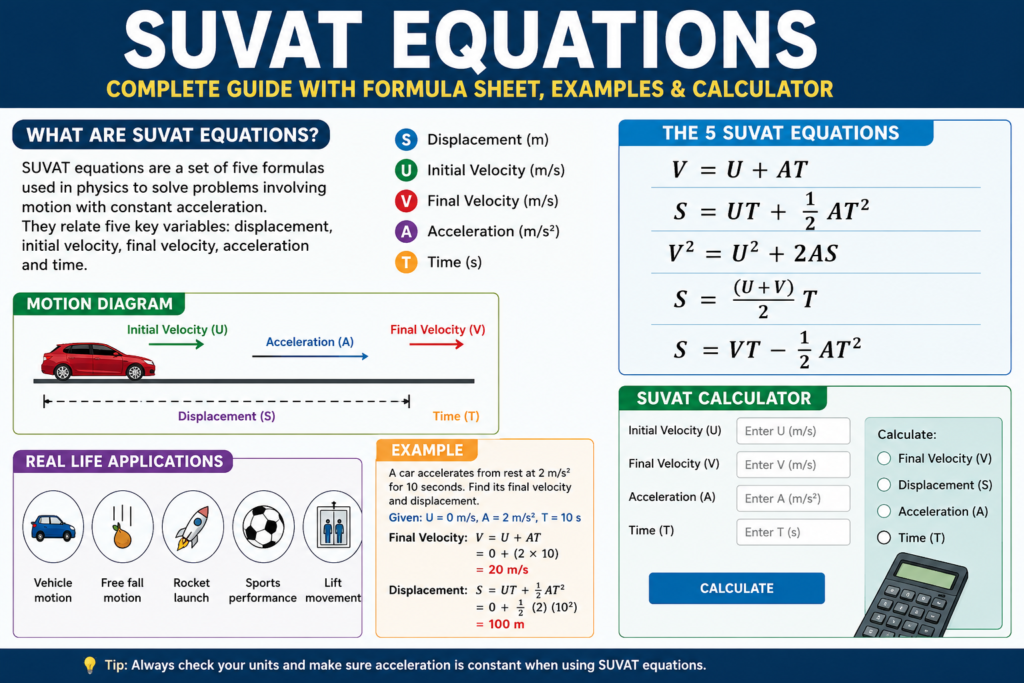
Suvat equations are a collection of mathematical formulas used to describe motion when acceleration remains constant. They connect displacement, initial velocity, final velocity, acceleration, and time, allowing you to calculate an unknown value when the others are known.
These equations are widely taught in schools and colleges because they form the foundation of kinematics. They are particularly useful in physics examinations and engineering studies, where understanding motion accurately is essential for solving real-world problems.
Understanding the SUVAT Variables
Each letter in the word SUVAT represents a different quantity used to describe motion. The letter S stands for displacement, U represents initial velocity, V means final velocity, A refers to acceleration, and T stands for time. Every variable plays an important role when solving physics questions.
Using the correct units is equally important. Displacement is measured in metres, velocity in metres per second, acceleration in metres per second squared, and time in seconds. Understanding these variables before applying suvat equations helps reduce mistakes and improves problem-solving skills.
Complete Suvat Equations Formula Sheet
The formula sheet contains five equations, each designed for situations involving constant acceleration. Every equation is useful depending on which variables are known and which value needs to be calculated. Students often keep a formula sheet nearby while revising because it provides quick access during practice sessions.
Rather than memorising equations without understanding them, focus on learning when each one should be used. This approach improves confidence during examinations and helps you apply the correct formula more efficiently when answering different types of motion questions.
How to Choose the Correct Suvat Equation
Choosing the correct equation begins by identifying the information provided in the question. List every known variable and determine which value you need to find. This simple habit makes selecting the appropriate equation much easier and reduces unnecessary calculations.
Another useful strategy is to identify the variable that is not mentioned in the question. Many physics problems are designed so that one equation naturally fits the available information. With regular practice, recognising the correct formula becomes almost automatic during exams.
Solved Suvat Equations Examples
Worked examples are one of the best ways to understand how these equations operate. Simple questions involving acceleration or final velocity help build confidence before moving on to more advanced problems involving multiple calculation steps.
Exam-style questions also demonstrate how physics concepts are applied in realistic situations. Solving a variety of examples improves mathematical accuracy, strengthens understanding of motion, and prepares students for assessment conditions.
Suvat Equations Calculator
An online calculator makes solving physics problems much faster by automatically performing calculations once the required values have been entered. It is especially useful for checking answers after completing manual calculations during revision.
Although calculators save time, students should still understand the underlying formulas. Learning how calculations are performed ensures that you can solve problems independently during examinations where understanding is assessed rather than simple numerical answers.
Common Mistakes When Using Suvat Equations
One of the most common mistakes is confusing displacement with distance. Displacement measures the straight-line change in position, whereas distance refers to the total path travelled. Mixing these concepts often leads to incorrect answers in physics questions.
Students also forget to convert units before solving problems. Using kilometres instead of metres or hours instead of seconds creates calculation errors. Carefully checking units and confirming that acceleration is constant will greatly improve accuracy.
Practical Applications of Suvat Equations
These equations are not limited to classroom exercises. Engineers use them when designing transport systems, while scientists apply them to analyse moving objects. Understanding motion accurately is important across many scientific and technical careers.
Everyday examples include calculating vehicle braking distances, analysing sporting performance, studying free-falling objects, and understanding the movement of lifts or roller coasters. These practical uses demonstrate why learning suvat equations is valuable beyond school examinations.
Revision Tips for GCSE and A-Level Students
Effective revision begins with understanding each variable before attempting difficult questions. Create summary notes, practise worked examples, and regularly review the formula sheet to strengthen long-term memory and improve confidence before examinations.
Past papers provide excellent preparation because they expose students to different question styles. Completing timed practice sessions, reviewing mistakes carefully, and repeating challenging questions are proven techniques for achieving better physics results.
Conclusion
Learning suvat equations is an essential step towards mastering mechanics and constant acceleration problems. By understanding each variable, selecting the correct formula, and practising with worked examples, students can solve physics questions with greater confidence and accuracy.
Regular revision, consistent practice, and the use of reliable learning resources will help reinforce your understanding over time. Whether you are preparing for GCSE, A-Level, or university studies, a strong grasp of suvat equations will support your success in physics and related subjects.
Frequently Asked Questions
What are suvat equations used for?
Suvat equations are used to solve motion problems involving constant acceleration in physics.
What does SUVAT stand for?
SUVAT stands for displacement, initial velocity, final velocity, acceleration, and time.
How many SUVAT equations are there?
There are five standard equations used to solve constant acceleration problems.
When can suvat equations be used?
They should only be used when acceleration remains constant throughout the motion.
Can suvat equations be used for non-uniform acceleration?
No. Different methods, such as calculus, are required when acceleration changes continuously.
Which suvat equation should I use?
Choose the equation based on the variables you know and the value you need to calculate.
Are suvat equations included in GCSE Physics?
Yes. They are an important part of the GCSE Physics curriculum and frequently appear in examinations.
Are suvat equations used in A-Level Physics?
Yes. A-Level Physics builds on GCSE knowledge and uses these equations extensively.
What is the easiest way to remember suvat equations?
Regular practice, revision cards, and understanding the relationship between variables make memorisation much easier.
Can I use a suvat equations calculator during revision?
Yes. A calculator is useful for checking answers, although manual practice is essential for developing understanding.
What is the difference between displacement and distance?
Displacement is the straight-line change in position, while distance is the total length of the path travelled.
What are the SI units used in suvat equations?
Metres (m), metres per second (m/s), metres per second squared (m/s²), and seconds (s).
How do I solve suvat equations step by step?
Identify the known values, choose the correct equation, substitute the variables, calculate carefully, and check your units.
Where are suvat equations used in real life?
They are used in engineering, transport, sports science, vehicle safety analysis, and many other scientific applications.
What are the most common mistakes students make with suvat equations?
The most common mistakes include incorrect units, choosing the wrong equation, confusing displacement with distance, and applying the formulas when acceleration is not constant.